
-
 Moving Away From the Maximum Tolerated Dose
The FDA recently expressed a new commitment to testing cancer drugs at lower doses, rather than defaulting to the highest dose most people can tolerate.
by Marcus A. Banks
-
 The Individual Sphere of Influence
Can discussion of health inequities lead to actionable change?
by Marci A. Landsmann
-
 A Treatment That Came Just in Time
Cancer survivor Laurie Adami reflects on her experience participating in a clinical trial that ultimately contributed to the March 2021 approval of a CAR-T cell therapy for follicular lymphoma.
by Laurie Adami
-
 More Data on COVID-19 Vaccination and Cancer
Studies indicate that many people with cancer have an antibody response to the vaccines, but this response may be reduced or absent in certain patients.
by Anna Goshua
-
 Putting the Patient in the Driver’s Seat
In her new book, Cancer Support Community executive chair Kim Thiboldeaux offers advice to patients on how to steer their way through a cancer diagnosis, treatment and beyond.
by Kevin McLaughlin
-
 A Closer Look at Sarcopenia
Gastrointestinal oncologist and health services researcher Ryan Nipp discusses new research about how muscle quality correlates with cancer outcomes.
by Ashley P. Taylor
-
 Genetic Testing Gaps
Testing for hereditary mutations is increasingly recommended for people with cancer, but recommendations do not always translate into access to testing and appropriate counseling.
by Kate Yandell
-
 Rethinking Access to Disability Benefits
Advances in screening and treatment mean there are more cancer survivors than ever, but survivors who struggle to work can face difficulty getting disability payments.
by Jen Tota McGivney
-
 Expanding Immunotherapy
At a patient advocate event, researchers discussed how to extend the benefits of immunotherapy to more people.
by Kevin McLaughlin
-
 Should All Kids With Cancer Get Genetic Testing?
Testing children with cancer for hereditary mutations could impact their treatment and provide information relevant to other family members.
by Marcus A. Banks
A recently approved drug that targets RAS proteins meaningfully improves outcomes for people with this difficult-to-treat cancer.
by Sandra Gordon
Bring On the WavesA surfer’s love for the ocean guides her through breast cancer treatment and beyond.
by Cameron Walker
Does Exercise Benefit Children With Cancer?New guidelines recommend children and adolescents with cancer get regular physical activity to mitigate side effects from treatment.
by Erin O’Donnell
Can the CYP2D6 Gene Affect Tamoxifen’s Effectiveness?A recent analysis examined whether CYP2D6 metabolism influences tamoxifen response. The answer isn’t entirely clear.
by Ashley P. Taylor
-
 AACR OMB Statement and Call to Action
The AACR is deeply concerned that proposed OMB regulations would disrupt federal research grant giving, severely weakening a program that has supported American medical innovation for decades.
-
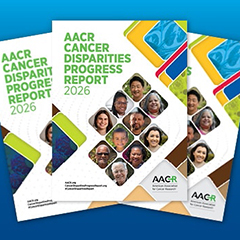 AACR Cancer Disparities Progress Report
The AACR Cancer Disparities Progress Report 2026 highlights recent progress in reducing cancer disparities and emphasizes the continued need for transformative research.
Cancer Research at a Crossroads
