
SCIENTIFIC DISCOVERY has long been a guiding force in Manju George’s life. In 1995, at age 23, she earned degrees in veterinary medicine and science in India, where she was born. She went on to receive a doctorate in veterinary virology in 2000, which allowed her to pursue a career in cancer research.
In 2003, George, who was 31, and her husband, C.B. Gurumurthy, moved from India to the U.S. with their son so they could seek new opportunities in biomedical research. Her career took an unexpected turn in 2012, when her second son, Sanjay, was born prematurely at 28 weeks. George—who was living in Omaha, Nebraska, and working as a researcher at the University of Nebraska Medical Center (UNMC) at the time—decided to take a remote, part-time administrative role so she could stay home with Sanjay, who had severe asthma.
George was preparing to return to a research position at UNMC when she learned she had rectal cancer. That diagnosis, on March 30, 2017, forced George to put her scientific pursuits on hold once more so she could focus on treatment and recovery. However, her experience with stage III rectal cancer shifted her focus from running experiments in the lab to providing practical support to others living with colorectal cancer.
“As a researcher, I was driven by curiosity. I wanted to identify something novel from a how-things-work point of view,” George says. “After my diagnosis, I wanted to be part of research that made a difference to people.”
Within days of receiving her diagnosis, George found an online support community for people with colorectal cancer called Colontown. As a newly diagnosed patient, she found information and encouragement in exchanges with other patients online. As a cancer researcher, she also felt a deep sense of obligation to share her knowledge. George began answering people’s questions in the online community and breaking down complex science for patients, survivors and caregivers. In addition, she thoughtfully followed up with members via online messages or phone calls.

Photo by Ron Blaylock
“When your whole life is out of control, it’s helpful to feel you can contribute to somebody else’s,” she says. “It kept me really busy, and if I was not doing something like that, I would have worked myself into a very stressed state.”
Ultimately, George’s expertise and desire to share information led her to help develop educational programming for Colontown. Over the years, she has developed content for Colontown’s CRC 101, a course for patients newly diagnosed with colorectal cancer, or CRC for short. She has also developed Empowered Patient Leaders Workshops to help teach those with the disease how to advocate for themselves and others. In 2020, George assumed the role of scientific director of Paltown Development Foundation, Colontown’s parent organization.
“To be able to walk with someone when they are at their most scared and vulnerable and to provide some assistance that’s of value has felt very impactful,” George says. “And because I’ve gotten to meet the brightest and best in gastrointestinal oncology, work with oncology fellows and get involved in spaces where decisions around colorectal cancer research are being made, the scientist in me is happy.”
Charting a Course After Diagnosis
Three years before she received her rectal cancer diagnosis, George’s endocrinologist had recommended a colonoscopy when her blood work showed a sharp dip in hemoglobin levels, a sign of iron deficiency that could also indicate the presence of colorectal cancer. But George had assumed the iron deficiency was caused by heavy menstrual bleeding and a past hypothyroidism diagnosis. She also worried about the invasiveness of the colonoscopy.
“I was a researcher then, and I thought I had a good level of health literacy,” George says. “The idea that someone my age could have colorectal cancer was not something that I knew.”
Still, even then, researchers were observing upward trends in colorectal cancer incidence among younger adults, although the pattern was not yet widely recognized. In fact, between 2012 and 2021, colorectal cancer cases rose by 2.4% per year in adults under age 50, even as cases dropped in older adults.
George noticed traces of blood on toilet paper and in her stool—signs that can indicate colorectal cancer—a month before her diagnosis. She also remembers feeling so exhausted that she had to ask a friend to take her younger son, then 4, to daycare, which was just a block from their home.
With her symptoms worsening, she went to an internal medicine specialist, who sensed her hesitation to get a colonoscopy and referred her to a colorectal surgeon to see what was going on. She underwent an in-office procedure in which the doctor used a scope to examine the rectum. After the doctor noted blood in her stool, George was quick to get a colonoscopy, which revealed a 2.8-centimeter tumor in her upper rectal area.
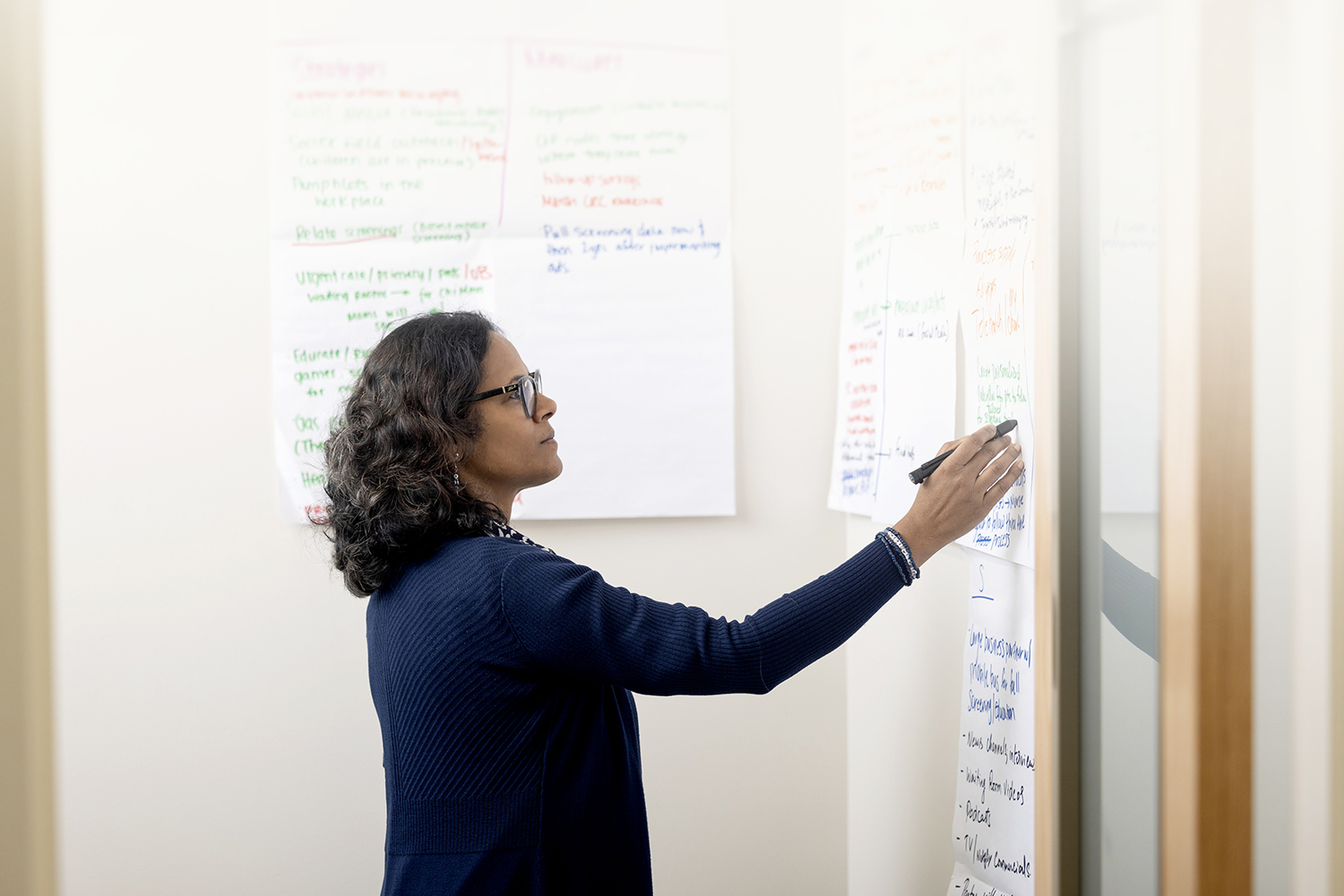
Photo by Ron Blaylock
When the tumor is located in the upper rectum area, doctors typically treat the cancer using the same approach as colon cancer, starting with surgery. (People with lower rectal tumors typically start treatment with radiation and chemotherapy to shrink the tumor.)
On April 25, 2017, George had surgery to remove half of her rectum, her sigmoid colon (the part of the colon nearest the rectum) and nearby lymph nodes. Two of these lymph nodes tested positive for cancer, which meant George would need to undergo chemotherapy. Her oncologist suggested she receive treatment with FOLFOX, a chemotherapy regimen containing leucovorin, 5-fluorouracil and oxaliplatin.
Advocating for Herself
In preparation for chemotherapy, George had a port implanted in her chest on May 22, 2017. Still, she continued to visit Colontown’s support community to read about different treatments and approaches. “My way of not getting stressed about it was to look at what other people were doing,” she says.
While online, she learned about a study that was presented at the 2017 American Society of Clinical Oncology Annual Meeting that looked at outcomes with different durations of FOLFOX and another regimen called CAPOX that pairs capecitabine—an oral drug that is converted to 5-fluorouracil in the body—with oxaliplatin. While the study showed that six months of FOLFOX was superior to three months of FOLFOX, it also demonstrated that three months of CAPOX could provide as much benefit as six months of CAPOX for stage III colon cancer.
George was eager to complete chemotherapy treatment as quickly as possible, so her oncologist agreed to the shorter duration of chemotherapy with CAPOX. The shorter treatment course and the oral medication would allow her to be present for her husband and two sons, then ages 4 and 15.
Training programs teach people to advocate for people with cancer in research and policy.
Many people who finish treatment are relieved to finally have cancer in their rearview mirrors, but others, like rectal cancer survivor Manju George, seek to use their experiences and skills to help those still navigating that journey.
People who are diagnosed with cancer often get a crash course in patient advocacy as they quickly find they must advocate for their own needs during treatment. Advocacy training programs can teach people how to effectively advocate for others, whether for policy changes or better research collaboration. For example, George completed the Scientist↔Survivor Program (SSP), which provides patient advocates an opportunity to learn from scientists at the American Association for Cancer Research (AACR) Annual Meeting. (The AACR publishes Cancer Today.)
The program allowed George to make broader connections with advocates. “SSP exposed me to many things which otherwise would not have been possible,” George says, including the U.S. Food and Drug Administration’s Oncology Center of Excellence, which enables advocates to get involved in discussions about patient-centered, collaborative regulatory decision-making.
Many cancer-specific nonprofit organizations, including Colontown, help patient advocates to advance skills.
Other nonprofit groups, such as the Research Advocacy Network and Guiding Research and Advocates to Scientific Partnerships, offer opportunities to integrate patient perspectives into research initiatives.
No matter a person’s level of expertise, empathy is among the most important characteristics of someone who takes up this work, George says. “Advocates also need to be open and curious and to learn as they go,” she says. “It’s definitely not for everyone, but if you are the right fit, the work is incredibly rewarding.”
During the first five days of each three-week cycle, George was so fatigued she couldn’t get out of bed. She had no appetite. After her second round of chemotherapy, she experienced hand-foot syndrome, a painful skin reaction on the palms of the hands and soles of the feet. To help care for George’s family, her sister traveled from India to stay in the house for six months.
As a person who describes herself as the one who “takes care of things,” George found the memory lapses that accompanied her treatment especially unsettling. “One time, someone on the phone asked me for my address, and I did not remember it. That was such a panicky moment,” she says. “I forgot entire weekends.”
After she completed treatment, George slowly recovered her mental sharpness, but she also remembers booking flights too early or late, missing doctor’s appointments, going to meetings she wasn’t scheduled to attend and following the wrong day’s schedule—unusual for the scientist who prized details and order.
“There was so much negative self-talk. It was really hard,” she says.
Finding Fulfillment by Giving Back
George was able to talk about these complicated feelings with members of Colontown, “When we go into a difficult experience, we want to share—not always with our family, but with somebody who understands,” she says.
While online, George found people who knew what she was going through and who provided practical suggestions, including recommendations for pelvic floor therapy to help strengthen muscles affected by her surgery and encouragement to join the YMCA’s Livestrong exercise program for cancer survivors. In turn, George shared her medical knowledge by providing information about how treatment works, sharing ideas for programming and offering one-on-one support.
Stacey Runfola, who turned to Colontown when her late husband was diagnosed with colorectal cancer, remembers reading George’s posts, which offered thorough explanations of complex treatments and research.
“If someone asked a question, you always wanted to read her answer because it was clear that she understood the science behind it, but it would be written in a way that we could understand,” says Runfola, who now serves as Paltown’s programs director.
George now provides patient-friendly educational content through her X account and a Colontown Educational Center blog. She also started DocTalks, a webinar series that features interviews with oncologists, radiologists, surgeons and researchers who put recent findings and treatments into perspective for patients.
“Having webinars with leading doctors was very unique when Manju started DocTalks,” Runfola says. “She’s constantly coming up with innovative ideas.”
As both a cancer survivor and researcher, George has served as a patient advocate on the Stand Up To Cancer Colorectal Cancer Dream Team and reviews clinical trial designs for the National Cancer Institute Rectal-Anal Task Force. She has provided her expertise to pharmaceutical companies to help shape clinical trial design that meets the needs of patients.
In June 2025, George and her family moved from Omaha to Madison, Mississippi, where she accepted a part-time role as an assistant professor at the University of Mississippi Medical Center. In addition, she chairs the Mississippi Colorectal Cancer Roundtable, which looks to improve colorectal cancer screening rates statewide. “It was dormant for a little bit, and my job is to revive it,” says George.
These efforts have allowed George to apply her scientific training to help democratize care so people with colorectal cancer have access to information. “When people go through something life-altering, it’s very raw and authentic. There’s no time for pretenses,” she says. “There’s a level of connection you feel to somebody going through it that’s hard to describe, and the feeling that you can do something to help them is transformative.”
It’s this authenticity, coupled with George’s scientific curiosity and drive to answer difficult questions, that allows her to reach patients who are often at their most vulnerable. Her compassion and work ethic have set an example not only for those she meets through online support groups but for her family. George’s older son, Addu, now 23, refers to his mother as “a human being at her finest,” noting that her life’s work exemplifies perseverance: “Life is so fragile, but why is that a reason to stop anyone?”
At the root of these efforts to help others is also unspoken courage. “I think that any trauma or scary things that happen in life immediately make us want to run away, and it takes a special type of person to stay within that trauma to help other people,” he says. “I don’t know how she does it, but I do know that she’s making a massive difference.”
Cancer Today magazine is free to cancer patients, survivors and caregivers who live in the U.S. Subscribe here to receive four issues per year.