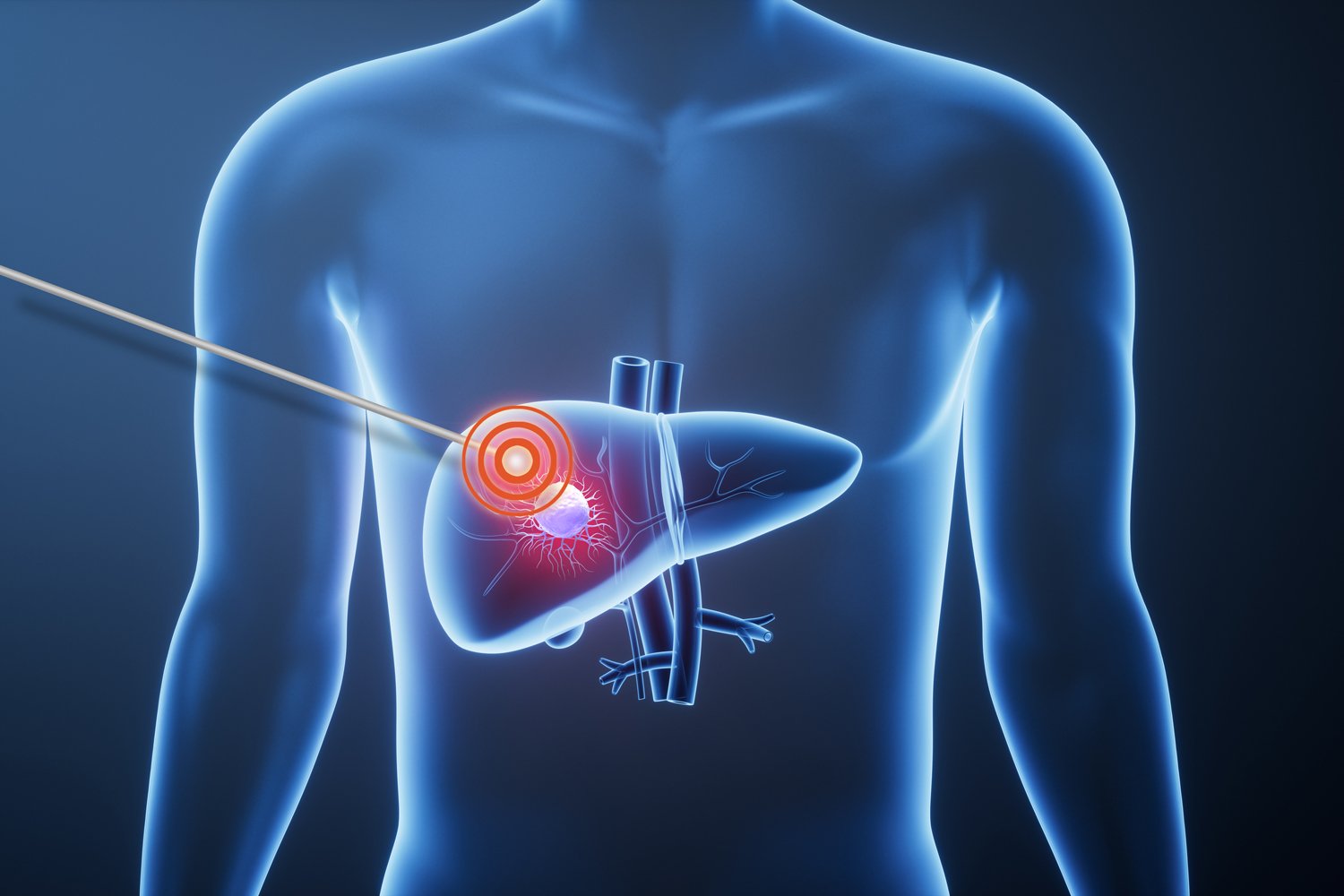
PEOPLE WITH SMALL LIVER CANCER TUMORS often undergo surgery to remove the tumor. But radiofrequency ablation (RFA)—a minimally invasive procedure that uses heat to destroy cancer cells—may achieve similar results with fewer side effects and a shorter recovery time.
In the SURF trial, researchers followed 1,055 people in Japan with hepatocellular carcinoma (HCC), the most common type of liver cancer, who had tumors that were 3 centimeters in diameter or smaller. Researchers randomly assigned 302 of the participants to undergo either surgery or RFA.
In results published June 24, 2025, in the Journal of Clinical Oncology, researchers found 74.6% of people who had surgery and 70.4% of those who had ablation were alive five years after treatment. The two groups also had nearly identical five-year recurrence-free survival rates (42.9% with surgery vs. 42.7% with ablation). Researchers concluded there was not enough evidence to show that one treatment was better than the other.
In the surgery group, 3.3% of people experienced mild to severe side effects, such as bile leakage, a potentially life-threatening condition that can cause abdominal pain and infection. No one in the ablation group reported side effects. Patients are more likely to have side effects if their tumors are near blood vessels or bile ducts, but no one in the trial had these types of tumors, according to Kiyoshi Hasegawa, a study author and a surgeon who specializes in liver cancer at the University of Tokyo Hospital. Additionally, people who had surgery stayed in the hospital for an average of 17 days, while those who had ablation stayed for an average of 10 days.
As part of the study, the remaining 753 participants could choose between surgery and ablation. While those who elected to have surgery had a better five-year recurrence-free survival rate (47.2% vs. 37.5%), researchers found similar proportions of both groups were alive after five years (79.8% vs. 78%). “The SURF trial findings suggest surgical resection and RFA are equally useful and effective as locoregional therapies for early-stage HCC,” Hasegawa says.
Ablation technology has evolved since the final study participants received treatment in 2015. Cancer patients now generally receive microwave ablation (MWA) instead of RFA. In both treatments, a doctor inserts a probe into the body and guides it to the tumor, where it applies heat to kill cancer cells. RFA produces heat through electric current, while MWA uses microwave energy, which heats up faster and distributes heat more evenly than electric current, according to Debashish Bose, the medical director of surgical oncology at Mercy Medical Center in Baltimore who was not involved in the study.
If a tumor is larger than 3 centimeters or there are multiple tumors, surgery is more likely to eliminate the cancer than ablation, according to Bose. However, if the tumor is 3 centimeters or smaller and located away from blood vessels, ablation may control the disease with fewer side effects, Bose says.
Nearly all trial participants had a single tumor, so it’s still unclear how effective ablation may be for people with multiple tumors, according to Bose. Additionally, the main causes of HCC in Japan and the U.S. are different, so the results might not fully apply to U.S. patients, Bose says. Three-quarters of study participants had hepatitis C, an infection that increases risk for liver cancer. However, rising obesity rates drive most cases of HCC in the U.S. People with liver cancer linked to obesity might have comorbidities that can affect long-term survival, Bose says.
If patients with small tumors cannot undergo surgery due to poor liver function or advanced age, Bose recommends they discuss minimally invasive approaches like ablation with their doctor. “For people who can’t have surgery, there are options that have the potential to prolong their lives,” Bose says. “We don’t want to deprive anyone of their best shot at surviving a cancer.”
Cancer Today magazine is free to cancer patients, survivors and caregivers who live in the U.S. Subscribe here to receive four issues per year.