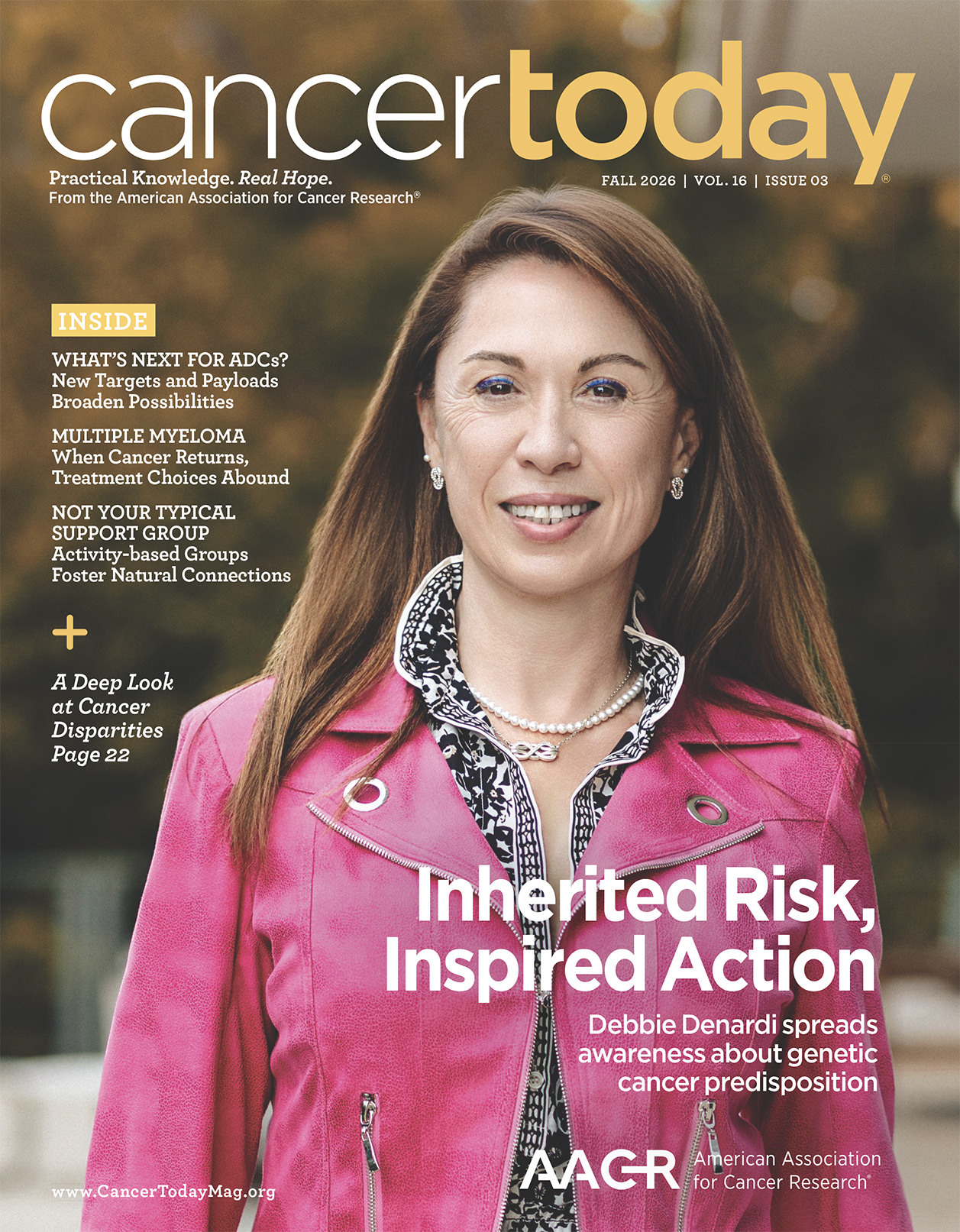

ACROSS THE U.S., researchers, scientists, doctors, advocates, patients and caregivers work to extend life and reduce suffering for people who have been diagnosed with cancer. We share that work every week on the Cancer Today website and four times a year in our print issue. Before closing the metaphorical book on this year, Cancer Today editors invite you to take a last look at some of our favorite stories from 2025.
Lessons Learned as a Caregiver and Patient
Share your story with other Cancer Today readers. Email your submission to [email protected].
In 2021, Miriam Díaz-Gilbert first wrote for Cancer Today to share her story as a caregiver after her husband, Jon, was diagnosed with stage IV rectal cancer. In 2025, she wrote about her own subsequent diagnosis of ductal carcinoma in situ, a noninvasive form of breast cancer that is commonly known as DCIS. In her personal essay, Díaz-Gilbert described how she was bolstered by the lessons she learned while caring for Jon, who currently has no evidence of disease, and how, with her diagnosis, she was also able to step more confidently into learning about her diagnosis and making treatment decisions. But the most valuable lesson she brought from both experiences may have been perspective. “I know my breast cancer might recur or that I might be diagnosed with a new cancer elsewhere in my body. But in the midst of cancer diagnosis, treatment, remission, recurrence and caregiving, we need to live our lives,” she wrote.
Once breast cancer has spread to other parts of the body, the aim of treatment is to keep the disease from growing for as long as possible. But the cancer often changes and develops treatment resistance. A story in the spring issue by Kendall K. Morgan describes how researchers have developed new treatments for metastatic hormone receptor-positive breast cancer to lengthen response. In the first-line metastatic setting, CDK4/6 inhibitors when combined with hormone therapy, have helped control cancer for longer periods of time. When cancer progresses, new options can overcome treatment resistance or target specific tumor biomarkers, such as the PIK3CA mutation. “Even if we can’t cure the disease, the promise is we’ll be able to switch from one treatment approach to another and have a series of therapies that may be helpful to extend life and hopefully maintain quality of life,” William Gradishar, a medical oncologist at the Robert H. Lurie Comprehensive Cancer Center in Chicago, told Cancer Today.
The Overlooked Issue of Hearing Loss
Cancer treatment is notorious for many side effects, including hair loss and nausea. But an article in the spring issue by Risa Kerslake explored a lesser-known effect from platinum-based chemotherapy: hearing loss. A study in JAMA Oncology examined hearing loss in 100 people with testicular cancer who were treated with the platinum-based chemotherapy cisplatin. After a median of 14 years from finishing chemotherapy, 54% of participants reported that they had symptoms of hearing loss, but audiology testing confirmed an even higher prevalence: hearing loss in 78% of participants. “Not only was their hearing bad right after chemo; it continued to get worse in the years that followed,” Victoria Sanchez, an audiologist at USF Health in Tampa, Florida, told Cancer Today. Hearing loss has been linked to other problems, such as cognitive decline and social isolation, said Sanchez, who led the study. She added that people about to begin cisplatin treatment should talk with their doctor about having a baseline hearing test and to advocate for continued regular testing to monitor for hearing changes.
A Champion for Organ Transplants
Since Lorrinda Gray-Davis received a life-saving liver transplant in 2018, she has worked to build support and community for other organ transplant candidates and recipient. Gray-Davis received a liver transplant after she was diagnosed with hepatocellular carcinoma, the most common type of liver cancer, at age 49. Recalling her own feelings of isolation during the transplant process, Gray-Davis established a statewide chapter of Transplant Recipients International Organization (TRIO) in Oklahoma to provide resources to others. In the midst of the COVID-19 pandemic, she also started an online support group for pre- and post-transplant patients—which continues under the auspices of TRIO. “People can come say, ‘I had a bad day; I want to give up,’ and we can say, ‘We love you. How can we help you?’ Being able to say what you’re going through and not being judged, that can be huge,” Gray-Davis told Sharon Tregaskis in a story for the summer issue.
Expanding Options in Esophageal Cancer
Less than half of people with esophageal cancer are eligible for surgery, often because the cancer has grown into nearby tissues. A story written by Risa Kerslake in the summer issue described early research that shows how the addition of immunotherapy could help make more people eligible for surgery. The study, published in Clinical Cancer Research, included 30 people with esophageal squamous cell carcinoma that had spread to nearby organs and were ineligible for surgery. Twenty-four patients had no progression after receiving standard chemotherapy and radiation and were then treated with the immunotherapy drug Tevimbra (tislelizumab) and chemotherapy. The treatment shrunk the cancer enough so that 20 participants went on to receive surgery, and 13 had no signs of cancer after surgery. The one-year progression-free survival for all participants in the study was 79.4%, while the typical rate expected for people with locally advanced disease who don’t qualify for surgery is 42%. Esophageal cancer remains aggressive, the story noted. In fact, up to half of patients who have surgery for esophageal cancer will have a recurrence. “Patients with particularly aggressive malignancies like esophageal cancer must consider both phases of cancer—the visible [tumor] and the microscopic cancer—when making treatment decisions,” said Daniel Boffa, a thoracic surgeon and chief of the division of thoracic surgery at Yale Cancer Center in New Haven, Connecticut, told Cancer Today. While he’s encouraged by the results, Boffa, who was not involved in the study, said surgery works best when cancers are caught before they spread to other parts of the body. Researchers will continue to follow the study participants to see five-year survival rates and are looking into biomarkers that may identify who is most likely to benefit from this treatment approach.
Treatment Combination Improves Survival in Platinum-resistant Ovarian Cancer
An investigational drug that blocks the effects of cortisol may help improve chemotherapy sensitivity in women with platinum-resistant ovarian cancer. In the summer issue, Sandra Gordon reported early data from an ongoing phase III trial that showed relacorilant, which blocks the effects of the stress hormone cortisol, when added to the chemotherapy nab-paclitaxel provided one-month improvement in median progression-free survival for people compared with chemotherapy alone. In addition, people who received relacorilant experienced a nearly five-month increase in median overall survival compared with those who just received chemotherapy. Although the trial is not yet complete, David M. O’Malley, a co-author of the study and a gynecologic oncologist at Ohio State University Comprehensive Cancer Center in Columbus, told Cancer Today that he expects to see more improvements in cancer control and survival. “We’re seeing people with sustained improvement in their disease, which will change the landscape of how we approach patients with platinum-resistant ovarian cancer,” O’Malley said. Relacorilant is an investigational drug that is only available for patients enrolled in clinical trials, but a drug application is currently under review by the Food and Drug Administration.
Ovarian cancer is the 11th most common cancer in the U.S., and only half of women who are diagnosed with the disease survive five years. A surprising observation that many high-risk ovarian cancers appear to start not in the ovaries but in the fallopian tubes has led to a new approach for preventing the disease. Pathologists, while examining specimens from people with high genetic predisposition to cancer who had surgery to remove their ovarian and fallopian tubes, have long observed that precursor lesions that can lead to high-grade serous ovarian cancers often appear on the finger-like structures of the fallopian tube, located near the ovaries. Removing the fallopian tubes in addition to the ovaries has been a common practice for women with a strong genetic risk for ovarian cancer. In his column in the fall issue, Cancer Today’s editor in chief, William G. Nelson, MD, PhD, director of the Johns Hopkins Kimmel Cancer Center in Baltimore, wrote about how researchers are now exploring whether women at high risk for ovarian cancer could have their fallopian tubes removed and delay ovarian removal. In the meantime, groups including the Society of Gynecologic Oncology recommend women who are done having children and are planning a pelvic surgery, such as hysterectomy or tubal ligation, consider having their fallopian tubes removed as a way to prevent the disease.
Aurora Lucas’ life was upended when she was diagnosed with stage III non-small cell lung cancer at 28 in 2021. She underwent radiation and chemotherapy and continues to take the targeted therapy Tagrisso (osimertinib), which blocks the activity of an abnormal EGFR protein caused by a mutation found in her cancer. In the fall issue, Thomas Celona wrote about the impact of Lucas’ diagnosis as a young adult. Medical bills pushed Lucas and her husband to rent out their house and move in with Lucas’ sister. As a young person with cancer, she felt alone even with strong family support. Eventually, she found connection with other young adults with cancer through a program called First Descents, a group that hosts free outdoor adventures for young adults diagnosed with cancer and other conditions. Hoping to help other young adult cancer survivors find resources and build community, Lucas has shared her experiences on social media. “It was a way for me to connect and actually help people know how to advocate in those rooms,” Lucas said of her social media posts, which go out to 10,000 followers across TikTok and Instagram.
Treating cancer that has spread to the brain has been a persistent challenge in cancer care. In the winter issue, Kendall K. Morgan wrote a story about how treatments have evolved. In the story, she describes how all patients received whole-brain radiation for brain metastases. Now, new targeted options are changing the landscape for some people with brain metastasis. For example, stereotactic radiosurgery, which delivers narrow high-dose beams of radiation straight to tumors, can provide tumor control for those with a limited number of brain metastases. In addition, new systemic therapies, such as antibody-drug conjugates and immunotherapy, are demonstrating an ability to control brain metastases. “We no longer assume that everything must be managed with radiation alone,” said Priscilla Brastianos, a neuro-oncologist at Mass General Brigham Cancer Institute in Boston. “Instead, we are combining systemic therapies with local treatments, including surgery and radiation, in ways that are thoughtful and evidence based.”
Young women take endocrine therapy, which is also called hormone therapy, to reduce their chance of breast cancer returning after treatment, but endocrine therapy can bring menopause-like symptoms, such as hot flashes and night sweats. Until this year, many women with a history of breast cancer were advised against using existing remedies, such as hormone replacement therapy, for managing these bothersome symptoms. On Oct. 24, 2025, the Food and Drug Administration approved nonhormonal Lynkuet (elinzanetant) to treat moderate to severe vasomotor symptoms caused by menopause in women ages 40 to 65. In the winter issue, Lindsey Leake reported the findings from a study published in the New England Journal of Medicine that found women taking endocrine therapy who took Lynkuet had fewer episodes of hot flashes and night sweats than those who took a placebo. Endocrine therapy is typically prescribed for at least five years after treatment for hormone receptor-positive breast cancer, but side effects can cause some women to stop taking the therapy. This new drug approval for managing hot flashes and night sweats in women in menopause may also help women remain on endocrine therapy. “We can improve their quality of life, but we can also improve the cancer control by allowing them to continue the [endocrine] treatment,” said Fatima Cardoso, a medical oncologist at Champalimaud Clinical Centre in Lisbon, Portugal, and president of the ABC (advanced breast cancer) Global Alliance.
Cancer Today magazine is free to cancer patients, survivors and caregivers who live in the U.S. Subscribe here to receive four issues per year.