
LOCAL IMMUNOTHERAPY INJECTIONS may allow people with precancerous lesions to avoid surgery and its associated side effects, according to results of a phase I clinical trial presented April 21 at the American Association for Cancer Research (AACR) Annual Meeting 2026 in San Diego. (The AACR publishes Cancer Today.)
Precancerous lesions affect about 5% of people in the U.S. These lesions can have up to a 36% risk of progressing to oral cancer, according to the researchers. Lesions are typically surgically removed, but they often come back. In addition, surgeries remove tissue from the tongue and other parts of the mouth, which can make talking and eating difficult or take away the ability to do so altogether. Many people will get multiple lesions, requiring repeated operations that further exasperate these problems.
“The mouth is the main conduit to so many different functions, including speaking, eating, drinking and breathing. Think about the last time you had a sore spot in your mouth, how debilitating that was. Now imagine a patient who has to undergo surgery at many locations in their mouth, over and over again as the lesions recur,” Moran Amit, the study’s presenter and a head and neck surgeon at the University of Texas MD Anderson Cancer Center in Houston, said in a press release.
The study enrolled 29 people with at least one lesion that had a high risk of progressing to oral cancer because of its size, location and pathology. Participants in the clinical trial received either a 10- or 20-milligram dose of an immunotherapy drug called Opdivo (nivolumab) directly into the precancerous oral lesions. Researchers investigated using just 2% to 4% of the typical intravenous dose. They hypothesized that direct injection of the immunotherapy would limit toxicities associated with systemic therapy.
Six people had their lesions disappear, and 19 of the 29 patients who received the injections had their tumors shrink by half or more. “For the first time, we are able to show that using a nonsurgical approach, we have 85% clinical response using immunotherapy,” Amit said at a press conference. One year after treatment, 75.8% of the treated lesions had not progressed to cancer and had not needed surgery.
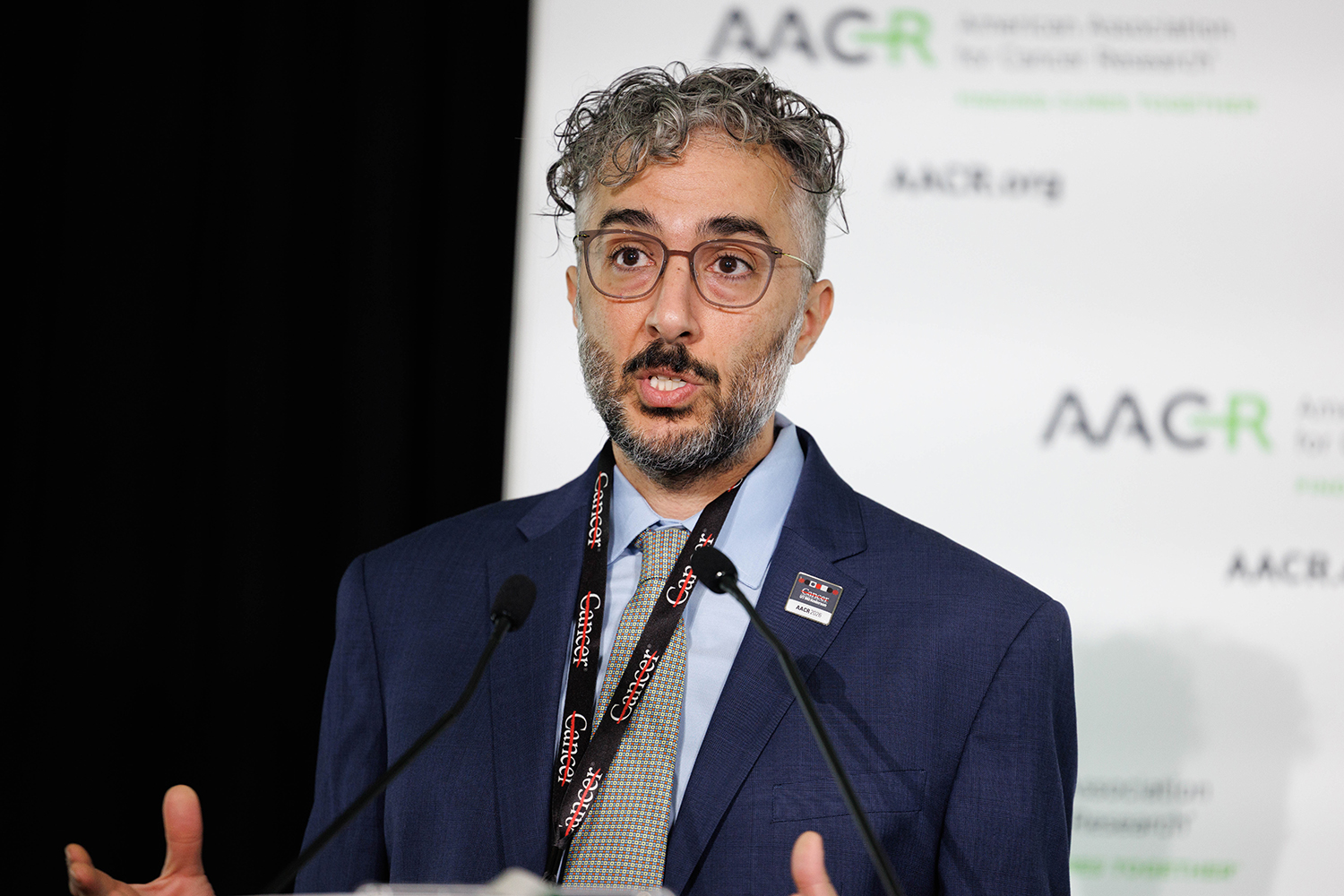
Moran Amit, a head and neck surgeon at the University of Texas MD Anderson Cancer Center in Houston, presents results of a clinical trial that evaluated local immunotherapy injections in people with precancerous lesions. Amit presented the results April 21 during the American Association for Cancer Research Annual Meeting 2026 in San Diego. Photo by © AACR/Scott Morgan
Jessica Lutterman, 40, came to Amit after twice undergoing surgery for tongue cancer in 2019 and 2022. Both surgeries caused intense pain and impaired her ability to eat and talk. “That’s the thing about oral cancer; I feel like it just strips you of your dignity,” Lutterman tells Cancer Today. “Both times my kids were really young. I couldn’t read their bedtime story. I couldn’t even watch them by myself because I couldn’t stop them if they were doing something dangerous.”
When doctors found two lesions in her mouth in 2025, her husband encouraged her to seek alternatives to surgery. They looked into different options and eventually arrived at the University of Texas MD Anderson Cancer Center. Lutterman enrolled in a follow-up to the presented study, despite the uncertainty of entering a trial and the cost of traveling to Texas from her home outside of Pittsburgh. She enrolled in the clinical trial after clinicians reassured her she could return to standard care immediately if the lesions progressed.
Because the phase II clinical trial will compare treatment against a placebo, Lutterman does not know whether she got treatment or what dose. However, a biopsy 12 weeks after her final injection found no precancerous cells at the treatment site. The study allowed only one area to be treated per person to find if the effect would spread to untreated lesions. The second lesion on the floor of her mouth remained. Since it has remained stable, Lutterman says, researchers continue to monitor it for progression to cancer.
Researchers reported that side effects observed in the current trial included fatigue, diarrhea and rash. These effects resolved without the need for medical care, Amit said. In addition, 40% of people had mild reactions at the injection site, which also cleared without medical intervention.
If larger studies confirm these results, doctors may de-escalate treatment for many patients, preserving tissue and maintaining their quality of life, Amit said. “I’m a surgeon, I love to operate, that’s what I’m doing, but I didn’t really want to give unnecessary surgery to those patients. So to me, 75% surgery-free survival is amazing.”
Cancer Today magazine is free to cancer patients, survivors and caregivers who live in the U.S. Subscribe here to receive four issues per year.