
A PHASE II CLINICAL TRIAL suggests a single infusion of a chimeric antigen receptor (CAR) T-cell therapy can eliminate detectable disease for long periods of time in people with high-risk smoldering myeloma.
Smoldering myeloma is an asymptomatic blood cancer precursor where abnormal plasma cells accumulate in the bone marrow and produce M protein. About half of people with high-risk smoldering myeloma develop active, symptomatic multiple myeloma within two years of diagnosis.
Researchers presented data from 20 people with this cancer precursor who received Carvykti (ciltacabtagene autoleucel) and who were assessed for measurable residual disease (MRD). Results from the trial, called CAR-PRISM, were presented April 20 at the American Association for Cancer Research (AACR) Annual Meeting 2026 in San Diego and simultaneously published in Nature Medicine. (The AACR publishes Cancer Today.)
“This is the first study of CAR T-cell therapy in a precursor cancer setting where [Carvykti] was used as primary therapy with no induction or bridging therapy for patients with high-risk smoldering myeloma,” Omar Nadeem, a study author and a medical oncologist at Dana-Farber Cancer Institute in Boston, said in a press conference.
Shifting the Strategy in High-risk Smoldering Myeloma
Physicians often use active monitoring for high-risk smoldering myeloma, waiting to start treatment until it progresses to active multiple myeloma, when signs, such as calcium elevation, renal failure, anemia or bone lesions, are detected. More recently, in November 2025, the Food and Drug Administration (FDA) approved a targeted therapy called Darzalex (daratumumab) for high-risk smoldering myeloma after a study showed the drug could reduce the risk of disease progression or death by 51% compared with active monitoring, but less than 10% of people in the study had a complete response to treatment.
Patients often remain on this drug for years without achieving deep molecular responses, said Ecaterina E. Dumbrava, a medical oncologist at the University of Texas MD Anderson Cancer Center in Houston who moderated the discussion at the press conference.
Carvykti, however, uses a fundamentally different approach to preventing disease progression than Darzalex does, according to Dumbrava. “It’s a one-time BCMA-generated CAR T-cell therapy to really intercept the disease early on,” she said. “The results of the CAR-PRISM trial really raise a very, very important question about whether early immune interception could not only just delay the progression, but can we potentially redefine treatment goals?”
The FDA approved Carvykti in April 2024 for adults with relapsed or refractory multiple myeloma who have received at least one previous therapy, such as an immunomodulatory agent or a proteasome inhibitor. Carvykti is a CAR T-cell therapy where a patient’s own immune cells are removed and engineered to target the BCMA protein found on multiple myeloma cells and then reintroduced into the body.
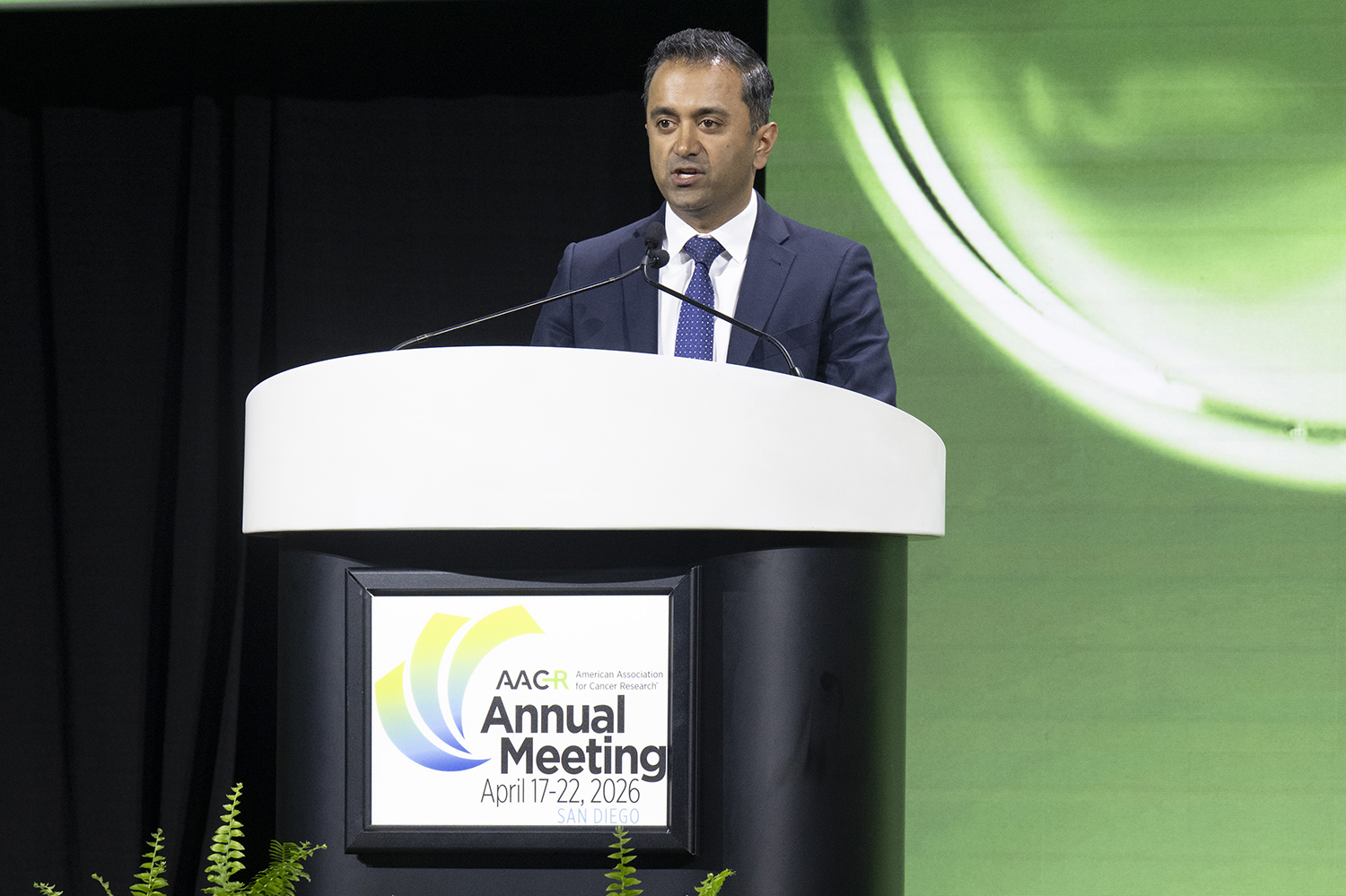
Omar Nadeem, a medical oncologist at Dana-Farber Cancer Institute in Boston, presents results of a clinical trial that tested a chimeric antigen receptor T-cell therapy in people with high-risk smoldering myeloma. Nadeem presented the results April 20 during the American Association for Cancer Research Annual Meeting 2026 in San Diego. Photo © AACR/Phil McCarten
Researchers hypothesized that Carvykti could be an effective approach before high-risk smoldering myeloma advances. “The rationale is that the immune system is less altered in smoldering myeloma,” Nadeem said. Because a patient’s T cells are still robust and have not been exhausted by years of cancer and treatment, they may respond better to immunotherapy, he explained.
“The tumor burden is lower in this disease state, and the plasma cells are less genomically complex,” Nadeem said. “Therefore, we hypothesize that efficacy may be enhanced, toxicities may be reduced, and with this one-and-done approach, there would be this lack of exposure to standard-of-care induction regimens, which can be reserved [for] the time of myeloma progression, if these patients ever progress.”
Inducing Responses and Managing Side Effects
In the trial, 20 people with high-risk smoldering myeloma received a single Carvykti infusion after a short course of chemotherapy. Before treatment, eligible patients could also choose to collect stem cells that could be used to treat potential future disease progression.
Patients achieved MRD negativity within two months of treatment and remained MRD-negative after a median of 15.3 months of follow-up. During the study duration, no patients were diagnosed with multiple myeloma.
Most patients in the trial developed cytokine release syndrome (CRS), although most cases were mild. CRS occurs when a rapid release of proteins called cytokines causes systemic inflammation. A few patients experienced upper respiratory tract infections that were treated with intravenous immunoglobulin.
No patients developed immune effector cell-associated neurotoxicity syndrome (ICANS), which causes an overactive immune response in the central nervous system. Seven people experienced non-ICANS neurologic side effects, including cranial nerve palsies, a known side effect of Carvykti that can impair eye movement, vision or facial sensation. Four cases resolved.
“All three of those patients [with ongoing side effects] are working; they’re living their lives like they were before,” Nadeem said. “There’s some mild limitation, whether it be a slight tremor that one patient has or slight issue with fine motor skills in some of those patients. But they certainly had improvement throughout the course of this [trial] and some of the interventions that we had done [like dexamethasone].”
More research is needed to determine if this treatment can prevent smoldering myeloma from progressing to multiple myeloma, according to Nadeem. “This is not an [FDA] approval-finding study,” he said. “Despite the results, we can’t go and prescribe this outside of the context of the clinical trial. But I do think it raises a lot of interesting questions going forward about the power of these types of therapies in these earlier disease states.”
Researchers are also studying bispecific T-cell engagers like Tecvayli (teclistamab) and Lynozyfic (linvoseltamab), which is approved for relapsed or refractory multiple myeloma, for smoldering myeloma.
Cancer Today magazine is free to cancer patients, survivors and caregivers who live in the U.S. Subscribe here to receive four issues per year.