
CANCER TREATMENTS, including some immunotherapies, targeted therapies and radiation, can damage the thyroid’s ability to produce hormones. Researchers think these therapies initially cause thyroid hormone levels to rise; however, as the drugs destroy thyroid follicles, the gland loses its ability to produce hormones, causing hypothyroidism.
A poster presentation at the American Association for Cancer Research (AACR) Annual Meeting 2026, held April 17 to 22 in San Diego, showed that hypothyroidism following immunotherapy and radiation was associated with improved survival. (The AACR publishes Cancer Today.)
Researchers analyzed health data for 9,909 adults with various cancer types treated with immune checkpoint inhibitors, tyrosine kinase inhibitors or radiation between 2006 and 2023. People included in this study had no prior history of thyroid disease or thyroid cancer.
During a median follow-up of nearly four-and-a-half years, 22% of people developed hypothyroidism. Those with treatment-induced hypothyroidism lived longer than those without the side effect. People who developed hypothyroidism from treatment had a 14% lower risk for death from any cause and a 24% lower risk for cancer-related death than those who did not develop the condition.
“Hypothyroidism has the potential to be a clinical biomarker,” Harry D. Momo, a doctoral epidemiology researcher at the University of Michigan School of Public Health in Ann Arbor, tells Cancer Today. “When patients are being treated with cancer drugs and they have hypothyroidism, that can be a sign that they [will] have better survival.”
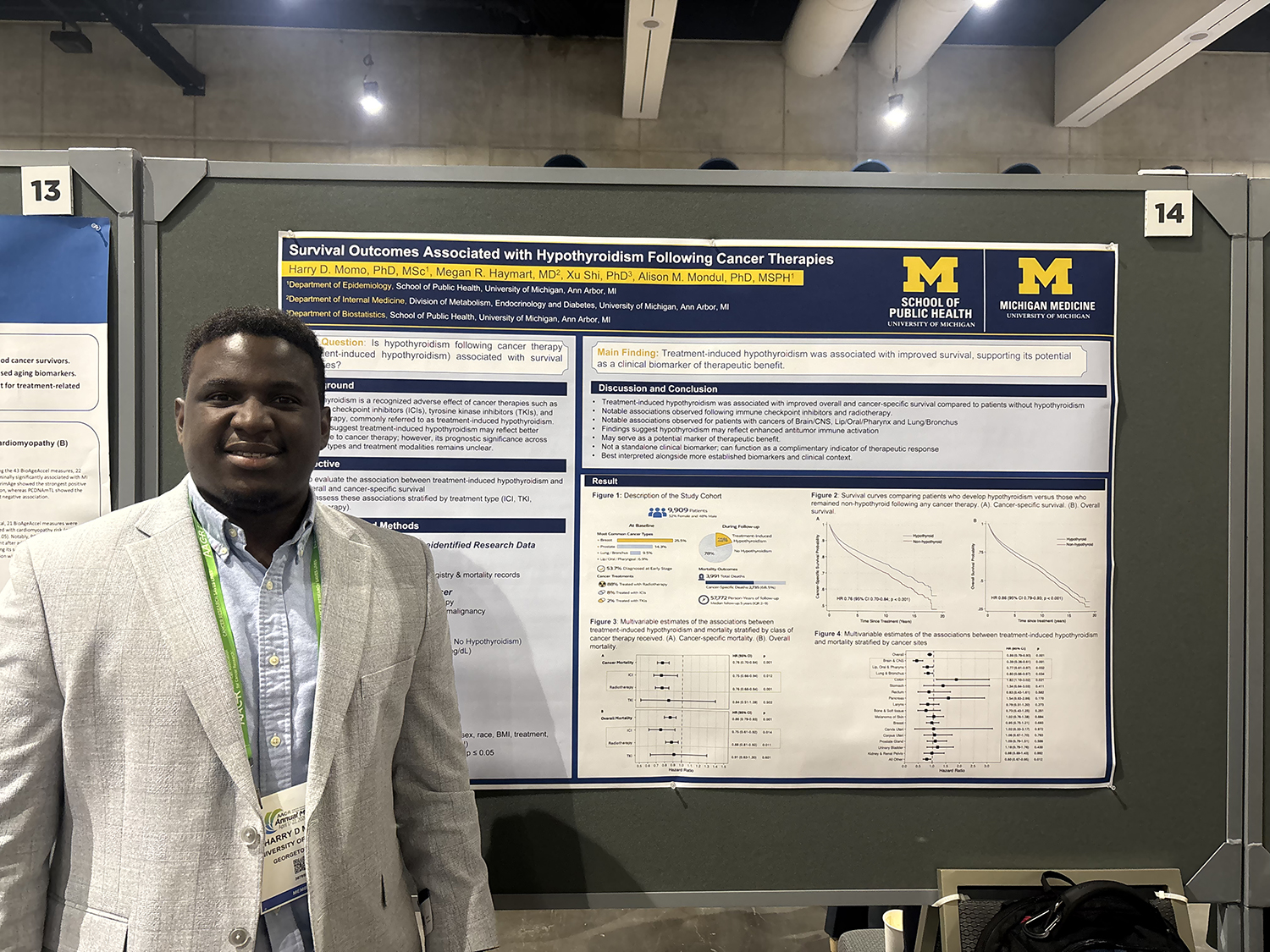
Harry D. Momo, a doctoral epidemiology researcher at the University of Michigan School of Public Health in Ann Arbor, presents research during the American Association for Cancer Research Annual Meeting 2026, held April 17 to 22 in San Diego. Photo by Darlene Dobkowski
Subgroup analysis found these survival benefits varied by treatment type. People treated with immunotherapy who developed hypothyroidism had a 25% lower risk for both cancer death and overall mortality. Similarly, hypothyroidism from radiation correlated with a 12% lower risk for death from any cause and a 24% lower risk for death from cancer.
Survival outcomes also varied by cancer type. People with brain and central nervous system cancers had a 61% lower risk for death. People with lip, oral cavity and throat cancers had a 23% reduction in mortality risk, and those with lung cancer had a 20% lower risk for death. Conversely, those with colon cancer who developed hypothyroidism had an 82% higher risk for death.
Upon developing hypothyroidism, clinicians can prescribe thyroid hormone replacement therapies like levothyroxine to manage the condition. Momo notes that clinicians monitor patients using thyroid function tests, though the effects of hypothyroidism may not completely disappear after cancer treatment ends.
“It can be scary when you hear you have any medical conditions,” but, Momo says, “I don’t think [hypothyroidism is] overall a bad thing in this case. It can be a good thing [showing] treatment [benefit] and then survival outcomes.”
Cancer Today magazine is free to cancer patients, survivors and caregivers who live in the U.S. Subscribe here to receive four issues per year.