IN OCTOBER 2024, Carolina Millon, a former retail executive in Falls Church, Virginia, anxiously checked her email and found a notification that she had new test results from a recent breast biopsy ready to view. She took a deep breath before clicking on the link. As a carrier of mutations in the BRCA2 and CHEK2 genes, Millon underwent routine screenings every six months, rotating between mammograms and MRIs. She had long planned to schedule a prophylactic double mastectomy after her 40th birthday in December 2024.
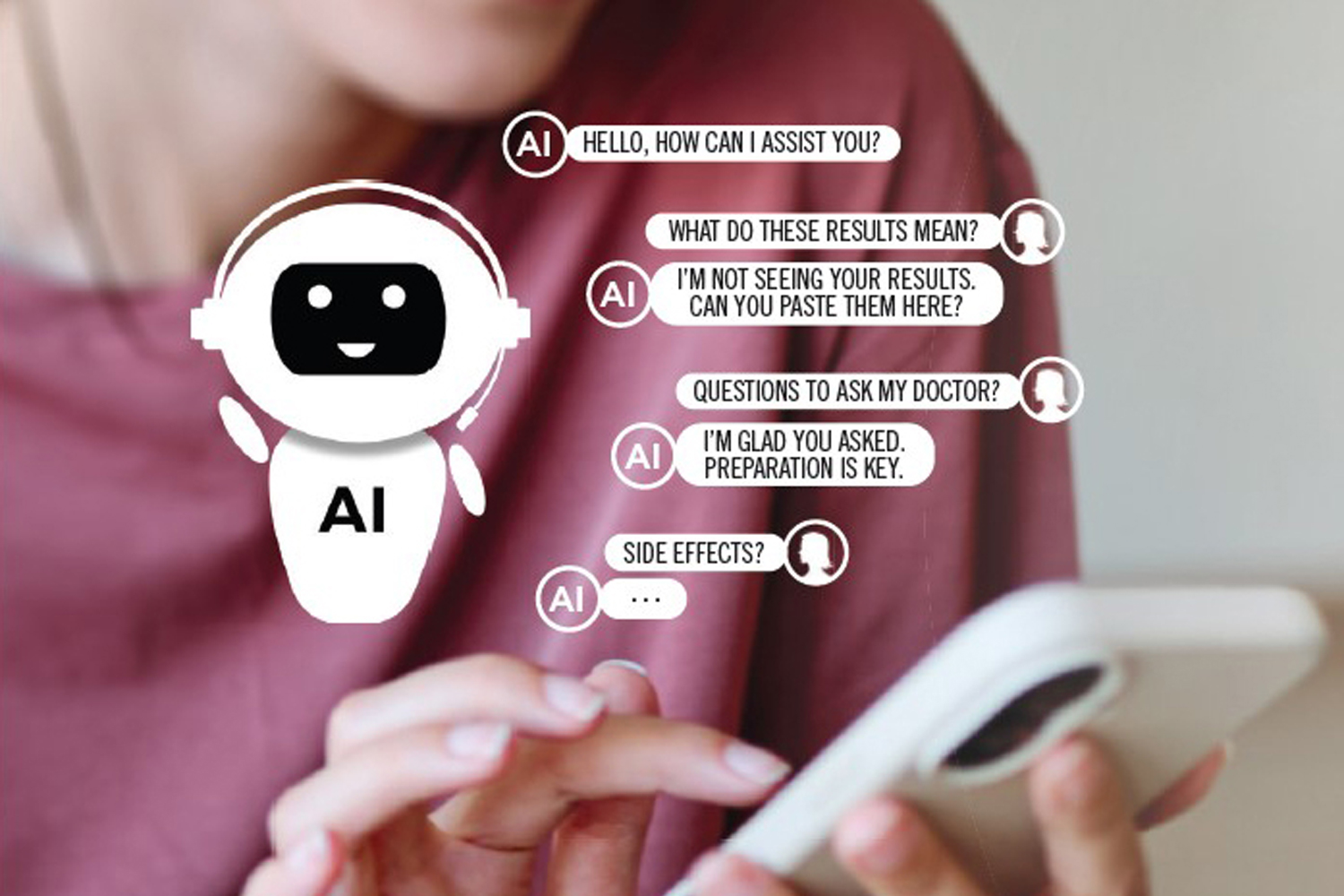
While reviewing the biopsy report, Millon tried to work through the jargon and scientific terms. As someone who had done considerable research on her cancer risk, she knew when she read words like “malignant” and “invasive ductal carcinoma” that she had cancer. However, the results came before she had the chance to discuss them with her doctor. Millon became anxious; she didn’t know how aggressive the cancer was or her prognosis. So she turned to ChatGPT, the large language model chatbot developed by OpenAI.
She uploaded a screenshot of the report and asked the chatbot to help her make sense of the results. Within seconds, it had translated the report into plain language, describing the stage of both cancers (one in each breast). “I had a much stronger baseline understanding of what was happening and what those biopsy results meant,” she says. After she read the summary, she requested a list of questions to ask her oncologist for when she called three hours later. Since then, as she’s undergone a mastectomy, chemotherapy, targeted therapy and endocrine therapy, she’s used ChatGPT to help her navigate often-confusing terminology. “It doesn’t replace medical advice,” she says, “but it is a fantastic bridge to help you engage better with your medical team.”
ChatGPT is an example of an AI chatbot. Others include Claude, Microsoft Copilot and Google Gemini. These programs give users access to tools called large language models, or LLMs. In essence, LLMs are word-prediction tools. They train by analyzing enormous amounts of text—trillions of words from the internet and hundreds of thousands of published books—and identifying connections among words and phrases that often appear together. Developers program these tools to predict answers to questions from users based on those connections. If a person asked about the most common side effects from chemotherapy, for example, the LLM might respond by listing loss of hair, fatigue and nausea. These answers are based on probability, not accuracy: What’s the most likely answer to the question?
These chatbots are already immensely popular. Survey results released in August 2024 by KFF, a nonprofit health policy organization, suggest about 1 in 6 adults in the U.S. use AI chatbots at least once a month to get health information and advice. (A more recent survey by OpenAI, published in January 2026, found more than half of respondents had turned to AI tools for health care advice over a timespan of three months and estimated that 40 million people worldwide used AI for health care daily.)
“There is so much potential” to help people, says Liz Salmi, who lives in Sacramento, California. She was diagnosed with a malignant brain tumor in 2008. Since then, the patient advocate and researcher has studied ways to better improve communications between patients and providers. She sees AI as a powerful tool for patient education.
To get the most out of the tools, she says, users should also know the technology’s shortcomings. Some studies suggest AI chatbots can perpetuate false assumptions and misinformation that could ultimately put patients at risk. For a study released April 15, 2025, by researchers from the University of Southern California, the investigators posed more than 500 cancer-related questions to popular chatbots, including ChatGPT, Gemini and Claude, that included myths or misinformation. In more than half of their responses, all the models failed to correct the errors.
Researchers share strategies to improve the quality of the responses you get from AI.
In the June 27, 2025, issue of the Cancer Letter, researchers from Moffitt Cancer Center shared early findings from their study into patient interactions with AI chatbots. The researchers collected cancer-related questions that people ask AI chatbots and assessed the accuracy of the answers. Their analysis led them to compile a list of six recommendations for patients who want to ensure that they’re getting safe, reliable information.
- Provide clear context. When you enter your question into ChatGPT, include specific information about your diagnosis, like the type and stage of cancer and your symptoms and treatments. Avoid vague questions, and, for safety, do not enter any personal information like your name or address.
- Use follow-up questions to request clarity. Studies have shown that with direct guidance, large language models (LLMs) can offer reliable information.
- Verify sources. If a chatbot’s answer seems unclear, ask it for links to the information sources or other references. Trustworthy sources for cancer information include the National Cancer Institute, peer-reviewed journals or articles, and professional oncology organizations like the American Association for Cancer Research (AACR) or the American Society of Clinical Oncology. (The AACR publishes Cancer Today.)
- Confirm that the information is up to date. Many LLMs are trained on data that are already a few years old, and cancer treatment guidelines change rapidly. Ask the chatbot to only refer to recent data, or prompt it to only gather data from the last year. If you’re not sure, confirm the information with credible sources.
- Ask the chatbot for guidance on communicating with your doctor. You can use AI tools to generate lists of questions and concerns about your diagnosis, treatment and side effects, and your providers can help you clarify other questions that come up.
- Discuss your use of AI with your care team. Let your provider know how you are using AI tools to better understand your diagnosis and ask for guidance.
AI models like the one that powers ChatGPT may produce erroneous answers in response to questions, also known as hallucinations. In June 2025, researchers from Moffitt Cancer Center reported that when they fed common patient questions to AI chatbots, some models generated responses that included misinformation or harmful information. A research study released in July 2025, conducted by researchers across the United States, similarly looked at how well four popular chatbots respond to hundreds of medical questions that patients often ask primary care providers. To varying degrees, the responses had the potential to “lead to serious harm,” often by not responding to early symptoms of cancer. The chatbots responded to queries about changing bowel habits without mentioning colon cancer, for example, suggesting that AI models might falsely reassure people that new symptoms are benign when they are not.
But researchers have highlighted approaches that can make AI models more reliable. One study published Sept. 11, 2025, in JMIR Cancer found that AI models that only used information from verified cancer research sources consistently provided accurate information.
Maria Alice Franzoi, a medical oncologist at the Institut Gustave Roussy in Villejuif, France, points out that AI is a rapidly evolving field, with tools now being used regularly not only by patients but also by clinicians and researchers. But their appeal for patients is undeniable. They provide answers to questions in real time, right in people’s homes when they might not be able to reach their doctor. They also help people share information with family and friends.
Franzoi cautions that AI chatbots can’t replace the expertise or guidance of human health care providers. “While AI can help reduce information overload, it shouldn’t interfere with the relationship between patients and clinicians,” she says. However, she sees AI tools as poised to help improve that communication.
Patients need to be aware of the risks of misinformation, notes Salmi, and to learn to use the tools responsibly. “We need to study this so deeply because there’s potential for harm,” she says.
Perils and Pitfalls
There’s plenty of room for error in a system that prioritizes probability over accuracy, but that same design means that chatbots convincingly portray a humanlike tone in their responses. Even though they’re not human, the models can communicate in a way that can put a patient at ease or help reduce anxiety, Franzoi says.
“LLM-based agents have shown an ability to provide empathetic responses comparable—and sometimes superior—to those of clinicians,” she says. “They can help patients prepare for medical encounters.”
Salmi sees parallels between today’s warnings about the potential risks of AI and past warnings about using the internet for medical advice. When she was first diagnosed with brain cancer in 2008, she was told not to search her symptoms or information about her cancer online because she might not understand the information or might get misinformation. But just as people learned to seek out information using reliable websites via search engines, Salmi believes patients can learn how to use LLMs responsibly for information. Moreover, she believes information pulled from multiple sources, presented in an easy-to-read format, can serve patients as they navigate communication with their care team.
She once used ChatGPT to help write a letter to her physician about use of a new medication for a condition not directly related to her cancer diagnosis. She uploaded more than a dozen scientific studies on the medication to ChatGPT and prompted the AI chatbot to write a short letter to her doctor about why the medication was worth considering. She sent the letter to her provider. At her next appointment, Salmi’s provider thanked her for sending the letter, and the two of them agreed that Salmi would switch to the new medication.
Salmi is currently doing research to learn how patients can use AI tools to improve their knowledge. In a study published April 9, 2025, in JAMIA Open, Salmi and collaborators came up with a list of questions based on a real clinical note from a neuro-oncologist for a patient with a brain tumor. They fed those questions to three chatbots, using different orders and wording, to assess how the phrasing of the question affected the accuracy and empathy of the answers. For some tests, they posed as patients. For others, they preceded the question with the prompt, “You are an expert oncologist who specializes in brain cancer.” Finally, they asked a team of neuro-oncologists and patients to assess the answers in terms of accuracy, empathy, relevance and other metrics.
The models varied in terms of accuracy, but Salmi says that, in general, directing the AI model to respond as an expert oncologist improved the overall ratings of the answers. What this proof-of-concept study shows is that how a person asks the question to an AI model can shape the accuracy and benefit of the answer. Salmi also argues that instead of discouraging patients from using tools like ChatGPT for medical guidance, health care providers should encourage patients to develop skills that make them more savvy users. She encourages people who are going to use AI to learn what she calls “AI literacy,” which means learning more about the strengths and limitations of the tools and learning how to frame a question to get the most accurate information.
Evidence-based App and AI-powered Comic Books
LLMs can give patients a way to quickly make sense of complicated information, says Maya Said, the founder and CEO of the app Outcomes4Me, which she founded in Boston in 2017. She designed the website, which can be used on a smartphone or computer, to provide patients with evidence-based information about symptoms and treatment options.
Outcomes4Me’s app uses AI to field patients’ questions by referencing information provided by the National Comprehensive Cancer Network (NCCN), which is a not-for-profit organization that publishes professional cancer treatment guidelines.
An AI-based platform that uses evidence-based guidelines for answers can analyze a person’s medical notes, compare them with the NCCN guidelines and produce recommendations in accessible language. Outcomes4Me also uses AI to find and send users relevant information about clinical trials that match their diagnosis.
In addition to learning about their diagnosis and treatment, people with cancer are also exploring AI chatbots in unexpected ways. For 73-year-old Cate Heroman, an educator and writer who lives in Baton Rouge, Louisiana, ChatGPT offered a way to talk to her four grandchildren about her diagnosis of large B-cell lymphoma in April 2025.
As her treatments began, she noticed how her grandchildren were hesitant around her. “The first time I came home, they seemed scared of me,” she says. To help her communicate about her own cancer, Heroman turned to two sources: her nurse and ChatGPT. When she was looking for information, she would point to the clear infusion bags containing the drugs and ask the nurse, “What’s that drug? What does it do?” Then, she’d ask ChatGPT to explain what the drug does in terms that a child would understand.
The chatbot’s responses clearly described how Polivy (polatuzumab vedotin), one of the drugs she received, targeted receptors on cancer cells. “That sounds like a superhero,” she recalls. “I could see him zipping around my body.” By the end of her treatments, she’d used ChatGPT to create a comic book detailing the adventures of five superheroes, each representing one of the targeted drugs or chemotherapy drugs she received, who could fight off lymphoma. “My goal was never to write a comic book,” she says. “But I wanted a story that a parent or grandparent could print out, share with a child and make it not so scary.”
As she built the story, page by page, using ChatGPT, she double-checked the information with her nurse. The last thing she wanted to do was mislead her own family.
Experiences like Heroman’s show that AI technologies can be helpful when paired with guidance from health care providers. With more people turning to tools like ChatGPT or Claude to understand health care concerns, patients must learn to recognize AI’s strengths and limitations, Franzoi says. It’s also important, she says, for researchers to continue studying how people are using these tools—in order to establish best practices in the future. Right now, she says, researchers only have a tenuous grasp on how AI usage affects patient experiences.
“We still need much stronger data on how these tools affect patients and health care systems in everyday practice,” Franzoi says, “including their impact on engagement, distress, quality of life and the overall quality of care.”
Cancer Today magazine is free to cancer patients, survivors and caregivers who live in the U.S. Subscribe here to receive four issues per year.