
-

Facts and Stats
Cervical Cancer TrendsFewer women in the U.S. are being diagnosed with the disease, but rates vary by state.
by Thomas Celona
-
 Targeted Therapy Improves Pancreatic Cancer Survival
A recently approved drug that targets RAS proteins meaningfully improves outcomes for people with this difficult-to-treat cancer.
by Sandra Gordon
-

From the Editor-in-Chief
Keeping Score: Cancer Incidence, Mortality and SurvivalShifting federal priorities threaten to undermine cancer mortality and survival gains.
by William G. Nelson, MD, PhD, DSc
-

Forward Look
Can Using GLP-1s Alter PET-CT Scan Results?Nuclear medicine physician David Djang eases concerns that popular weight loss and diabetes drugs may interfere with imaging interpretation.
by Natalie Slivinski
-

Forward Look
A Gentler Conditioning Regimen for LeukemiaChildren and young adults with no evidence of acute lymphoblastic leukemia after chemotherapy may be able to avoid radiation prior to stem cell transplantation.
by Lindsey Leake
-

Forward Look
Expanding First-line Therapy OptionsAn antibody-drug conjugate extends progression-free survival for people with advanced triple-negative breast cancer.
by Darcy Lewis
-
 When Donor Cells Attack
New strategies are reducing graft-versus-host disease, one of the most dangerous complications of a stem cell transplant.
by Sonya Collins
-
 Turning Resistance Into Opportunity
As treatments continue to improve outcomes for people with cancer, researchers seek to understand, anticipate and prevent drug resistance to keep the disease at bay.
by Kendall K. Morgan
-

Healthy Habits
Focus on Whole FoodsDiets high in ultraprocessed foods increase the risk for precancerous colorectal polyps in younger women.
by Anne Danahy
-

Facts and Stats
What Are Liquid Biopsies?Blood tests can detect signs of cancer and guide some treatment decisions, but traditional screening remains more effective for finding early-stage disease.
by Thomas Celona
A recently approved drug that targets RAS proteins meaningfully improves outcomes for people with this difficult-to-treat cancer.
by Sandra Gordon
Bring On the WavesA surfer’s love for the ocean guides her through breast cancer treatment and beyond.
by Cameron Walker
Does Exercise Benefit Children With Cancer?New guidelines recommend children and adolescents with cancer get regular physical activity to mitigate side effects from treatment.
by Erin O’Donnell
Can the CYP2D6 Gene Affect Tamoxifen’s Effectiveness?A recent analysis examined whether CYP2D6 metabolism influences tamoxifen response. The answer isn’t entirely clear.
by Ashley P. Taylor
-
 AACR OMB Statement and Call to Action
The AACR is deeply concerned that proposed OMB regulations would disrupt federal research grant giving, severely weakening a program that has supported American medical innovation for decades.
-
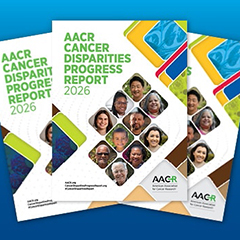 AACR Cancer Disparities Progress Report
The AACR Cancer Disparities Progress Report 2026 highlights recent progress in reducing cancer disparities and emphasizes the continued need for transformative research.
Cancer Research at a Crossroads
